
Interoperability is all about “achieving common goals together, despite organisational or geographical distance between actors” (European Commission, 2022). In practice, it means enabling different organisations, systems and technologies to work together rather than operating in isolation. In the digital context, interoperability also refers to the ability of information systems to exchange data and enable the sharing and reuse of information (European Data Protection Supervisor, 2018).
For the livestock sector, this distinction is particularly important. Farmers, advisors, researchers, milk recording organisations, technology providers and public authorities all generate or use data, but these data are often collected in different systems, according to different standards and for different purposes. Making these systems communicate is therefore not only a technical challenge: it is also a matter of cooperation, governance, trust and shared objectives.
The European Union (EU) is tackling the question of interoperability in many ways. For example, the EU is striving to find common European solutions such as the EU Digital COVID Certificate. It also encourages data-sharing and promotes the European common market for data. Moreover, the EU increases cooperation between regions and sectors through EU-funded projects and supports synergies between projects and stakeholders working on similar challenges.
This need for cooperation is also at the heart of European research and territorial cooperation programmes such as Horizon Europe and Interreg. Interreg, launched in 1990, specifically supports cooperation between countries, regions and communities to address challenges that cross borders. Horizon Europe, meanwhile, provides a framework for research and innovation projects bringing together organisations from different countries and sectors to address shared European and global challenges.
Both programmes therefore provide an important foundation for projects such as Digi4Live and HoliCow: bringing together complementary expertise, infrastructures and perspectives that would be much more difficult to mobilise within a single country or organisation.
Why does cross-border interoperability matter?
Many of today’s agricultural and societal challenges are shared across Europe, and their solutions require contributions from different actors; that’s why cross-border interoperability is needed. Ensuring food security and the production of sustainable and safe food, resolving challenges related to animal welfare and disease outbreaks, improving mitigation of and adaptation to climate change, and digital transformation of the food system are issues that require knowledge and coordinated action between countries, regions and stakeholders.
For project coordinators working across borders, cooperation provides several concrete benefits:
- First, it allows stakeholders to share best practices and successful approaches and learn from challenges and failures.
- Second, cooperation can reduce development and implementation costs of new technologies and solutions, which is one of the key motivations for cooperation.
- Third, cross-border cooperation improves access to expertise and innovation and strengthens data-sharing and common standards.
- Finally, cooperation can help create solutions that are more transferable and scalable. When partners agree on common approaches from the beginning, the resulting tools and methodologies have greater potential to be adopted beyond the original project or region.
For Digi4Live, interoperability is therefore not only a technical issue, but also a matter of collaboration, trust and governance. Farmers, researchers, advisors, policymakers and technology providers need systems that can communicate effectively while ensuring transparency, security and data sovereignty.
Technical interoperability alone, however, is not enough. It is also important that collaborators are motivated to both share and receive knowledge, data and other means that are critical for a successful outcome of cooperation.
For the HoliCow project, interoperability has enabled partners to share good practices, exchange perspectives and broaden their ideas. Discussions, brainstorming and the pooling of our expertise and resources have been a real asset to the project. This collaborative approach has contributed to the development of a tool that can be applied across different contexts, while remaining flexible enough to reflect the specific needs and realities of each partner and region.
At the same time, there is room for improvement. Many digital solutions in agriculture remain fragmented, using incompatible systems and isolated data structures. Greater standardisation and stronger cooperation between projects, regions and stakeholders will be necessary to fully unlock the potential of digital agriculture.
Why does data interoperability matter in agriculture?
Data interoperability is the ability of different digital systems to exchange data and, crucially, to interpret and use that data in a meaningful way. This goes beyond simply being able to transfer a file from one system to another. Two systems may technically exchange data while still being unable to understand each other if they use different definitions, units, identifiers or structures.
In agriculture, interoperable systems can help to reduce administrative burden, improve decision-making, increase efficiency and support more sustainable farming practices.
The challenge: fragmented agricultural data
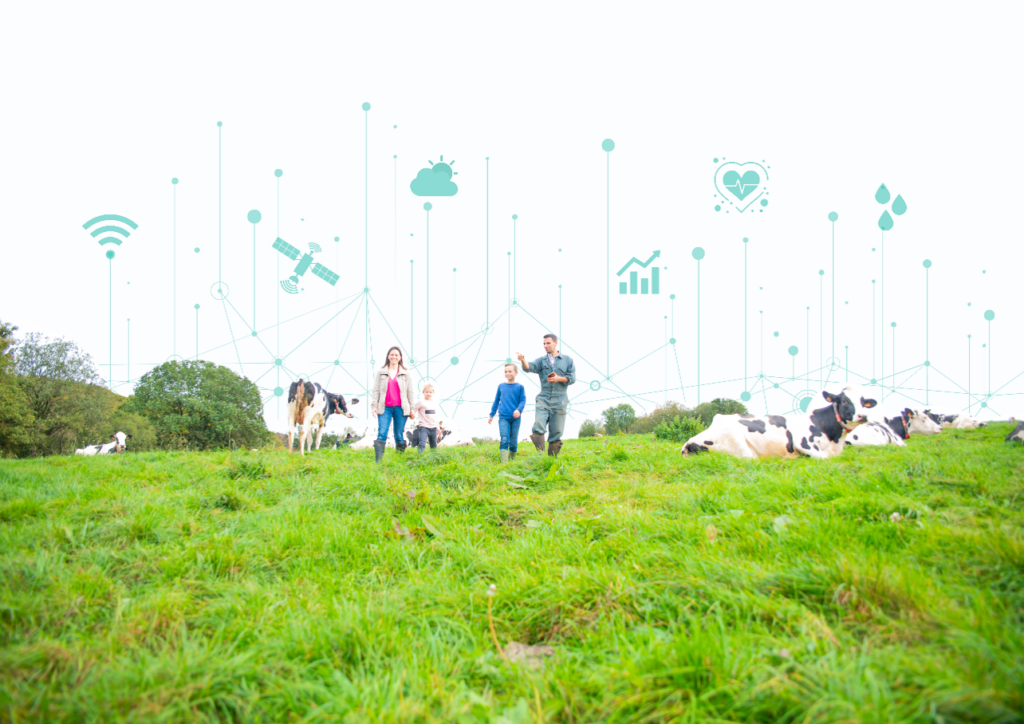
Agriculture generates enormous amounts of data from many different sources, including farm management software, sensors, machinery, laboratories, milk recording organisations, public authorities and other stakeholders. However, this information is often collected for different purposes and stored across separate systems and formats. As a result, valuable data can remain fragmented and difficult to access or use.
The Farm Foundation (2023) highlights the need for better connections between digital solutions and data sources across the agricultural sector. While many tools are already available, they often operate independently rather than as part of a connected data environment. This can make it difficult to combine information from different sources while maintaining control over how data is shared and used.
Without interoperability, farmers and agricultural organisations may have to enter the same information into multiple systems, work with disconnected tools and face difficulties when trying to make effective use of existing data. This fragmentation can slow innovation, increase administrative work and make it more difficult to scale digital solutions.
Projects such as Digi4Live and HoliCow are working to address these challenges by exploring practical approaches to connecting digital tools, improving data exchange and supporting more integrated digital solutions for the livestock sector.
Two complementary approaches: Digi4Live and HoliCow
Digi4Live: a global approach
The Digi4Live project adopts a broad and collaborative approach to interoperability in the livestock sector. Rather than focusing on a single technological solution or isolated dataset, Digi4Live aims to strengthen the overall digital ecosystem surrounding livestock farming.
The project promotes cooperation between farmers, researchers, advisors, policymakers, technology providers and regional actors to improve digital integration and facilitate knowledge exchange across borders.
Digi4Live contributes to interoperability at different levels:
- Technical interoperability, by encouraging compatible digital systems and data exchange mechanisms;
- Organisational interoperability, through stronger collaboration between stakeholders and regions;
- Knowledge interoperability, by sharing best practices, experiences and innovative approaches among partners and Case Study actors.
The project also recognises the importance of secure and trustworthy data-sharing frameworks that preserve data sovereignty while enabling meaningful collaboration.
Through case study activities and a multi-actor collaboration model, Digi4Live demonstrates how digital innovation can contribute to more sustainable, resilient and competitive livestock farming systems across Europe.
HoliCow: making milk recording data work across borders
HoliCow provides a more specific example of how data interoperability can be addressed in practice.
At the heart of HoliCow is a transnational database (around 63 million spectra) based on data collected through milk recording organisations. The project combines mid-infrared (MIR) spectral data with other information to develop indicators related to animal health and welfare, production, fertility, environmental impact, milk transformation and climate resilience.
However, bringing data together from different countries and organisations was not that easy. HoliCow partners initially faced differences in data formats and structures, and the data could not be easily compared. Data harmonisation and standardisation therefore became a fundamental first step of the project.
By standardising the data, HoliCow enables partners to work with information on a common basis. This makes it possible to compare datasets, combine information and develop tools that are not restricted to a single country or data provider.
In this sense, HoliCow demonstrates a fundamental principle of agricultural data interoperability: the value of data increases when data from different sources can be combined, understood and reused without losing their meaning or control.
The collaboration between Digi4Live and HoliCow
Digi4Live and HoliCow have decided to collaborate and explore how their complementary approaches can contribute to greater interoperability in the agricultural sector.
Future activities and ideas include joint webinars, raising awareness among farmers and pilot farms, exchanges between stakeholders, policy monitoring activities, and the promotion of best practices related to digitalisation and data-sharing.
The collaboration between both projects reflects the growing importance of synergies between European projects working on digital transformation, sustainability and agricultural innovation. By combining complementary expertise and experiences, Digi4Live and HoliCow aim to contribute to a more connected, interoperable and farmer-centred agricultural ecosystem in Europe.
Explore our Newsroom and follow us on LinkedIn, Facebook, X, Instagram, and YouTube for the latest advancements in livestock farming.